Southeast Texas Suzuki Association

  • Home
  • About
    • About Us
    • The Suzuki Method
    • Board of Directors
    • Donate to STXSA
    • Contact
  • Become a Member
  • Find A Teacher
  • Events
    • Student & Parent Events
    • Teacher Events & Meetings
    • Other Events
  • Photos & Video
  • Members Only
    • STXSA Forms
    • Meeting Minutes
  • My Account
    • Go to My Account

Parent Corner Newsletter Archives

Missed an issue? Just click on the date to read, download, or print a .pdf of a past Parent Corner Newsletter.  Enjoy!

2026
February 2026
January 2026

2025
October 2025
March 2025
February 2025
January 2025

2024
December 2024
November 2024
October 2024
September 2024
February 2024
January 2024

2023
November 2023
March 2023
February 2023

Parent Corner Newsletter January 2024

Author: Emmelynn Khan

Editor: Danette Warren

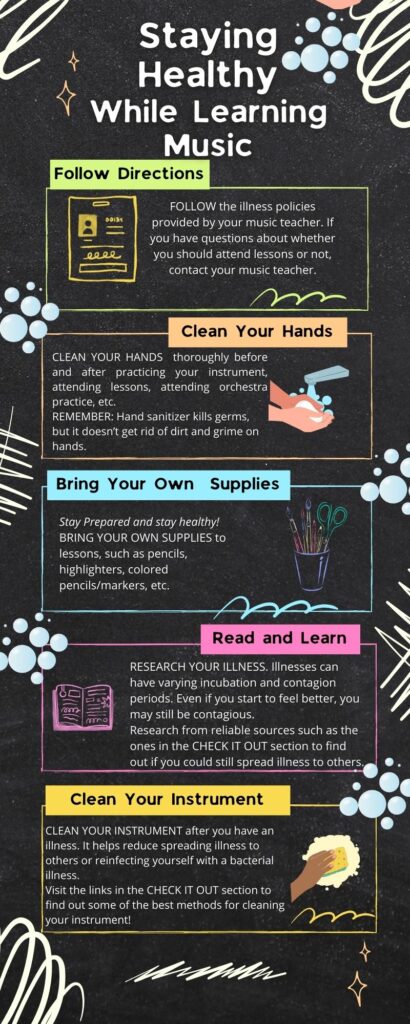
Check it Out!

Resources for illness information:
National Institutes of Health

Texas Department of State Health Services

Resources for Cleaning Your Instrument:
Cleaning Your Stringed Instrument:
Article by Wyatt Violin Shop*

*STXSA is not responsible for any damage that may occur by following the advice from these articles.

Article by Seman Violins (Includes Tips for Cleaning Varnish.)*

Parent Corner Newsletter December 2023
Unique Intelligences and Music
How Music Education Relates to the Intelligences
How Parents Can Support Their Child’s Unique Intelligences
References
Check it Out! Further Resources
Parent Corner Newsletter December 2023

Author: Emmelynn Khan

Editor: Danette Warren

Next Tab for Article>

Unique Intelligences and Music

Intelligence is a word one may often hear, but what is it, exactly? According to the National Library of Medicine, “Intelligence is the ability to learn from experience and to adapt to, shape, and select environments”1. Intelligence is not a single ability that one either has or does not have. Instead, intelligence comes in many different forms and combinations. According to renowned Psychologist and Harvard Research Professor Howard Gardner, there are at least eight types of intelligences: spatial, bodily-kinesthetic, musical, linguistic, logical-mathematical, intrapersonal, interpersonal, and naturalistic.

Below are descriptions of each of the eight intelligences:

Spatial Intelligence

Capacity to think in images and pictures, to visualize accurately and abstractly.2

Bodily-Kinesthetic

The ability to use one’s whole body, or parts of the body (like the hands or the mouth), to solve problems or create products. 3

Linguistic

Sensitivity to the meaning of words, the order among words, and the sound, rhythms, inflections, and meter of words. 3

Musical

Sensitivity to rhythm, pitch, meter, tone, melody and timbre. May entail the ability to sing, play musical instruments, and/or compose music. 3

Logical-Mathematical

The capacity to conceptualize the logical relations among actions or symbols. 3

Interpersonal

The ability to interact effectively with others. Sensitivity to others’ moods, feelings, temperaments and motivations. 3

Intrapersonal

Capacity to be self-aware and in tune with inner feelings, values, beliefs and thinking processes. 2

Naturalistic

The ability to make consequential distinctions in the world of nature as, for example, between one plant and another, or one cloud formation and another. 3

A child can have strengths and weaknesses in multiple intelligences. What is more, a child’s strengths and weaknesses may change over time.

Next Tab>

How Music Education Relates to the Intelligences

A child’s unique intelligence can help with his or her music education. You may notice your child picks up on certain concepts more quickly and efficiently than others. This may be that the concepts closely relate to your child’s stronger intelligences. What is more, music education can help your child develop and strengthen in other intelligences.

The chart below gives just a few examples of musical concepts relating to the various intelligences.

Intelligence

Musical Concept

Musical

Rhythm, pitch, meter, tone, melody and timbre.2

Spatial

Shifting, bowing articulation and techniques

Bodily-kinesthetic

Balance, movement, complex fingerings, contrasting body movements, holding an instrument/bow

Linguistic

Phrasing, dynamics, songs

Logical-Mathematic

Music Theory

Interpersonal

Interacting with other musicians, interpreting emotions of music, reading an audience.

Intrapersonal

Setting and intrinsically working toward music goals; recognizing, analyzing, and dealing with feelings during music, including anxiety.

Naturalistic

Listening and comparing/contrasting sounds.


Next Tab>
How Parents Can Support Their Child’s Unique Intelligences

It is important that a child has various learning opportunities available that align to his or her strengths. It also just as important that a child has multiple ways available to demonstrate what he or she has learned. “Since each human being has her own unique configuration of intelligences, we should take that into account when teaching, mentoring or nurturing. As much as possible, we should teach individuals in ways that they can learn. And we should assess them in a way that allows them to show what they have understood and to apply their knowledge and skills in unfamiliar contexts.” (OASIS). As parents, take note of what intelligences your child frequently demonstrates. Use your child’s strong areas of intelligence to help your child with practice activities at home. In addition, share what you observe with your child’s music teacher. It may help the teacher provide more individualized learning opportunities that correlate to your child’s strongest intelligences, as well as connect to and develop in the other intelligences. 

References

References:

  1. Garder, Howard. “The Components of MI.” MI Oasis, n.d. Accessed December 2023. https://www.multipleintelligencesoasis.org/the-components-of-mi
Check it Out! Further Resources

Learn more about Howard Gardner’s Multiple Intelligences Theory: https://www.multipleintelligencesoasis.org/

Parent Corner Newsletter November 2022
Introduction
The Elements of Meaningful Feedback
Tips for Creating Meaningful Feedback
A Suzuki Teacher's Perspective/ References
Check It Out!
Parent Corner Newsletter November 2022

Volume 1, Issue 3

Title: Meaningful Feedback

Author: Emmelynn Khan

Editor: Danette Warren

Next Tab for Article>

Introduction

Thanksgiving is around the corner! This holiday is often accompanied by the obligatory question: “What are you thankful for?” If your child said he or she was thankful for you, which of the following would be more meaningful?

“I am thankful for you.”

“I am thankful for you because you give me hugs and play with me.”

Did you find the second sentence more meaningful? While the first sentence is nice, it does not tell you WHY your child is thankful for you. The second sentence lets you know what makes your child feel thankful. The second sentence is an example of your child giving you meaningful feedback. When studying music, it is important for parents and teachers to give students meaningful feedback.

What is Feedback?

Feedback is any response to an action. It can be positive or negative, detailed or a general statement. Meaningful feedback is a response that helps a person understand what parts of their behavior are positive, what needs to be corrected, and why.


The Elements of Meaningful Feedback

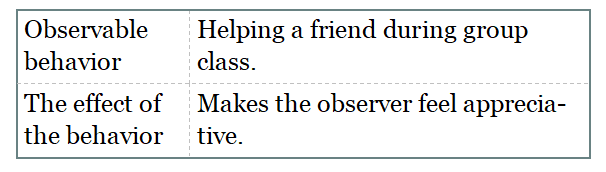
According to the Positive Behavioral Interventions and Supports educational framework, meaningful feedback has two key parts: a child’s observable behavior and how the behavior affects you, the observer.1

Suppose you tell your child, “I appreciate you helping your friend during group class!”

This remark contains both parts of meaningful feedback.
Next Tab>

Tips for Creating Meaningful Feedback

Use I-Statements

Using an I-statement format helps you to explain how a situation makes you feel without sounding accusatory.2

I statements use the following structure:

I  feel (emotion) when (explain the situation). 2

The following example shows how an I-statement can diffuse an accusatory statement:

Accusatory: “You never listen to me! Why do I even try to help you?

I Statement: “I feel frustrated when I take the time to help you, but you do not seem to listen.”

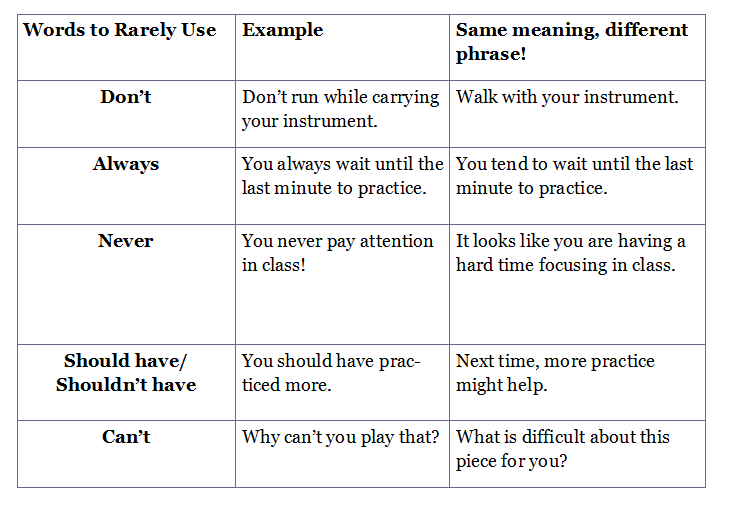
Carefully Choose Your Vocabulary

The words that are used in feedback can make a huge difference in how the feedback is received. Some words should be used sparingly to avoid a negative tone to your feedback.
A Suzuki Teacher's Perspective/ References

Alexander Revoal shares his take on positive feedback in the 2017 Suzuki “Parents as Partners” series. When giving positive feedback,3 

  • Be specific.

Focus on specific aspects of your child’s behavior.

Example: “You kept your pinky curved the whole time you were playing” instead of  “Good job with your bow hold.”

  • Tell the truth.

Be honest and stick with objective facts about what is happening rather than giving exaggerated statements.

Example: “Your intonation has improved since last week” instead of “that was the best music I have ever heard!”

  • Remove the child from the situation.

State what is happening or what needs to happen without crediting or blaming your child.

Example: “Raise your violin scroll upward” instead of “You have bad posture.”

  • Focus on effort/process rather than outcome

Center the majority of your feedback on elements of the learning process, rather than on the expected end result.

Example: “Try this part again. I want you to focus on the shift this time” instead of “That was wrong, play it again.”

  • Observe objectively and describe.

“It is important to give students the freedom to make mistakes, and one powerful way that we can do that is by recognizing that the task at hand is indeed a difficult one. For example, ‘It must have been difficult to concentrate when you heard the ice-cream truck outside.’ Finally, when all else fails, a hug and an ‘I love you’ can go a long way.”3

For the complete article, follow the link in our “Check it Out” section.

Creating meaningful feedback takes time and practice. It is never too late to start reflecting on the feedback you give and find ways to make your feedback more meaningful!

REFERENCES

  1. PBIS Rewards, “How Do I Give Positive Reinforcement?” PBIS Rewards, 2022. Accessed October 2022. https://www.pbisrewards.com/blog/how-do-i-give-positive-reinforcement/
  2. Therapist Aid, “ ‘I’ Statements.” Therapist Aid LLC, 2022. Accessed October 2022. https://www.therapistaid.com/therapy-worksheet/i-statements
  3. Alexander Revoal, “Crafting Constructive Positive Feedback.” Suzuki Association of the Americas, 2017. Accessed November 2022. https://suzukiassociation.org/news/crafting-constructive-positive-feedback-3/


Check It Out!

More information on I-Statements

 https://www.therapistaid.com/therapy-worksheet/i-statements

Alexander Revoal’s “Positive Feedback” article:

https://suzukiassociation.org/news/crafting-constructive-positive-feedback-3/


Parent Corner Newsletter October 2022
Introduction
What Does Review Actually Do?
How to Go from Passive to Active Review
References
Check It Out!
Parent Corner Newsletter October 2022

Volume 1, Issue 2

Title: The Importance of Review

Author: Emmelynn Khan

Editor: Danette Warren

Next Tab for Article>

Introduction

When I taught in a Special Education classroom, my reading students reviewed vocabulary words daily. Reviewing vocabulary didn’t mean sitting at a desk and going through flashcards. Sure, flashcards were available. But review was much more than that. 

Review was

  • Building vocabulary words with letter magnets.
  • Using a different color chalk for writing each letter or phoneme on the board with a friend.
  • Spontaneously finding and pointing out words in the books we shared in circle time.
  • Briefly pointing out a vocabulary word when I or a student used it in a conversation on the playground or during a different subject’s lesson.
  • Going around the room with a “treasure map” to find the hidden words around the room and to write them down.
  • Creating stories and illustrations that correlated to the vocabulary words.
  • Review was powerful!

 One student progressed from reading less than 20 words to reading over 110 words and  numerous simple sentences by the end of the school year. For the majority of people, learning something the first time is just the beginning of being able to successfully recall and use that information later on. Whether it is in reading or music, review is a complex and beneficial process that reshapes and strengthens your child’s mind. Review is a necessity.

What Does Review Actually Do?

Review is going over material that has previously been introduced. Going over the information again forces the brain to recall information. Synapses—or connections between neurons—are built. The creation of synapses strengthens the pathways in the brain that are connected and relay the information. The brain retains information best when connections are made from one subject to other subjects.

When multiple connections are made, the likelihood that the information will remain in a person’s long-term memory increases and will be recalled more quickly in the future.

However, review must be meaningful to be effective! Reviewing with a purpose allows the brain to actively make the essential connections. Your child must be engaged in the music and the techniques that are being reviewed.


How to Go from Passive to Active Review

As you have probably witnessed, review can be difficult for children. Younger children can easily lose interest in previously learned pieces. Older children often see review as a waste of their already limited time.

Suzuki violin and viola teacher Rafael Videira gives some suggestions for creating a fun and effective reviewing atmosphere to help your child be engaged in the process. Your child can

  • Tell a story with the music.

Your child can practice dynamics and phrasing to create a story with the review music.1

As a starter, consider brainstorming with your child and write down several nouns, verbs, adjectives, and adverbs on slips of paper—one color paper for nouns, one color for verbs, etc. Your child can choose one of each color slip of paper to create the outline for their story.

  • Express emotion through the music.

Your child can choose one or more emotions that they want to convey through the music. Your child can use dynamics, vibrato, phrasing, or various bow techniques to show that emotion.1

An emotion chart can be helpful to give your child different options to try.

You can find a chart in our “Check it out” section.

  • Play a recital for toys.

Set out stuffed animals, dolls, or encourage family to respectfully listen as playing through review pieces. Afterward, have a special treat if the student wants it.1

For older students, family or friends could respectfully listen to your child playing review pieces.  

  • Record him or herself while focusing on a specific technique.

Your child can play the recording and find areas to focus on in future practice sessions.1

  • Roll a die to pick review pieces and techniques.

Have a die with a review piece written on each side. Your child will roll the die to choose the review piece for that day. Your child can also roll a second die with techniques to focus on reviewing (i.e., shifting, vibrato, staccato bows, etc.).1

You can find blank dice forms in the “Check it Out” section.

Review is most effective when it is not rushed.3 To make the most of review, encourage your child to take their time, rather than timing their review. Strongly consider having your child break their review session into various days of practice. Just as the body needs rest to rebuild after exercise, effective review requires rest. This allows the brain to have the time to process and store the information from the review.2


References
  1. Rafael Videira, “Creative Strategies for Effective Review—a Survey of Favorite Activities from within the Suzuki Triangle.” Suzuki Association of the Americas, 2017. Accessed September 26th, 2022. https://suzukiassociation.org/news/creative-strategies-for-effective-reviewa/
  2. Oregon State University, “Memory: It’s a Process.” Academic Success Center at Oregon State University, 2022. Accessed September 28th, 2022. https://success.oregonstate.edu/learning/memory


Check It Out!

Free resources to help with review activities:

https://www.thepracticeshoppe.com/collections/free-digital-downloads

 Suzuki review information and ideas:

https://suzukiassociation.org/news/tags/articles-for-parents/review/

 List of Emotions Chart:

https://www.teacherspayteachers.com/Browse/Search:free%20emotions%20chart

 Blank Dice Template:

https://www.pgsd.org/cms/lib07/PA01916597/Centricity/Domain/43/Cubing%20thinkdots.pdf


Parent Corner Newsletter September 2022
Extrinsic Motivation
Intrinsic Motivation
Help! It's Not Working
References
Check it Out! Further Resources
Parent Corner Newsletter September 2022

Volume 1, Issue 1

Title: Motivation

Author: Emmelynn Khan

Editor: Danette Warren

Next Tab for Article>

Extrinsic Motivation

Let’s face it. As a parent, it can be a challenge to find the motivation you need to get everything done during the day; the challenge increases when you also have to help your child find the motivation to practice!

Helping your child stay motivated may not be as difficult as you think. The key is to find the motivators that are most meaningful to your child.

There are a number of different motivators which fall into two categories: extrinsic and intrinsic.

Extrinsic motivation comes from external sources such as1

Rewards, including prizes or the ability to participate in a special activity.

A student could practice for a certain number of hours in order to earn a prize.

Avoiding negative consequences, such as punishment or shaming.

Parents take away a privilege if their child does not practice.

 (NOT recommended in most instances)

Power over others, including leading others.

A student might be motivated to be a section leader in orchestra or  to lead a musical activity during group class.

Praise

Some students thrive on hearing about the positive aspects of their practicing, such as the progress they are making and the effort they are putting forth.

Competition

Structured competition at a developmentally-appropriate age can be motivating for some students. Middle school and high school students might benefit from competing in UIL and Region competitions.

Social respect

Having the ability to play a popular song on their instrument, holding a certain chair within orchestra, or knowing advanced techniques that others want to learn can all be social motivators.


Next Tab

Intrinsic Motivation

Motivation can also come from simply wanting to learn and enjoying the process of learning (Intrinsic motivation). Collaborating with your child’s music teacher will help support intrinsic motivation. Intrinsic motivators include1

Challenges

A student enjoys taking on and mastering new skills. Make sure there are new challenges readily available.

Curiosity (competence motivation)

A student wants pursue a technique, music style, skill, or anything else that piques their interest. Encourage your child to ask their music teacher to help them pursue their musical interests.

Control over part of their environment.

Give your child choices when practicing to help build their autonomy. Use dice, spinners, numbered popsicle sticks, choice cards, prop bags, or other selection tools to give your child opportunities to make choices.

Context—desire to see and use skills to solve problems or applying to other areas.

Gaining problem solving skills, learning how to break down assignments, memorization techniques or learning musical techniques that can be applied from one piece to another can all be motivators.


Next Tab>

Help! It's Not Working

You thought your child was motivated, when suddenly Susie couldn’t care less about earning an ice cream party, Krishna has no interest in learning new techniques…and you are pulling your hair out. Relax! Take a breath. Motivations change. What may have been motivating before to your child just doesn’t have the same appeal anymore. It may be time to find new motivators. Take a step back and consider the following:

 Where is your child developmentally?

As your child grows, his or her motivations will most likely change as well. At age 7, rewards may be a major motivator, while a 14 year old may be more driven by social respect from his or her friends.

Is your child still showing interest in the instrument?

 Your child may be feeling a lack of interest in their instrument if they are not inspired. Watching others perform, going to music camps, and attending workshops are several ways to grow your child’s interest in their music.

What else is going on in your child’s life?

Overly-committed in too many extra-curricular activities, difficulty in school, or family troubles can negatively affect your child. If your child is facing overwhelming stress and/or uncertainty, even the most attractive of motivators may not be effective. Try to keep your child’s experience with music as stress-free as possible. Encourage your child to only do what they feel ready for, take small steps, and let your child’s music teacher know about the situation. You and your music teacher’s support and encouragement is essential.

It can take time and multiple tries to find motivators that are right for your child. Keep trying, and Don’t be afraid to ask your child’s music teacher for ideas!

References

References:

  1. Charlotte Nickerson, “Differences of Extrinsic and Intrinsic Motivation.” Simply Psychology. Simply Scholar LTD, December 2021. Accessed August 29th, 2022. https://www.simplypsychology.org/differences-between-extrinsic-and-intrinsic-motivation.html


Check it Out! Further Resources

Sheet music for challenges, popular music, or pursuing new musical topics:

https://violinsheetmusic.org/

https://www.8notes.com/instruments/

Free resources to help with rewards, decision-making tools, or to help track a new challenge:

https://www.thepracticeshoppe.com/collections/free-digital-downloads

Decision-Making activities for parents and children:

https://empoweredparents.co/decision-making-games/


  • Facebook
  • Twitter
  • Instagram
  • Join
  • Contact Us

Copyright © 2026 Southeast Texas Suzuki Association | Site by: Katy Digital Marketing